
Dubai’s DXB Shatters Records: 44.9 Million Passengers in Just Six Months of 2024

Abhishek Nayar
10 Aug 2024

Dubai’s Al-Maktoum International Airport (DXB) has once again set a new benchmark in global aviation, welcoming a record-breaking 44.9 million travelers in the first half of 2024. This impressive figure, marking an 8% year-on-year increase, underscores the airport's critical role in connecting the world and supporting Dubai’s economic growth.
A Sky-High Surge: January Sets the Tone
The year kicked off with a bang as January 2024 alone saw 7.9 million passengers, setting the pace for what would become a historic six months. The total number of flight movements during this period reached 216,000, a 7.2% rise compared to the same timeframe in 2023. This surge not only highlights DXB’s status as a global travel hub but also reflects the growing demand for international connectivity.
Baggage Handling Excellence: A New Record
DXB’s commitment to efficiency is evident in its baggage handling statistics. In the first half of 2024, the airport managed a staggering 39.7 million bags, a 6.7% increase year-on-year, marking the highest-ever volume of baggage handled in this period. Impressively, 92% of all arriving baggage was delivered to guests within 45 minutes of their aircraft arriving on stand, showcasing DXB’s dedication to enhancing the passenger experience.
Passenger Insights: Who’s Flying Where?
The average number of passengers per aircraft movement was 213, with a steady load factor of 77% compared to H1 2023. Direct traffic accounted for 56% of total passengers, while transfer traffic made up the remaining 44%. These figures indicate a slight increase in direct traffic, suggesting that more travelers are choosing DXB as their final destination.
Q2 2024: Sustaining the Momentum
The second quarter of 2024 continued to build on the success of the first, with 21.8 million guests passing through DXB—a 7.5% increase compared to Q2 2023. During this period, the airport recorded 107,000 flight movements, further solidifying its position as a key player in the global aviation industry.

Key Source Markets: India and China Lead the Charge
India remains the top destination country for DXB, with 6.1 million passengers traveling between the two nations in the first half of 2024. The resurgence of China as a key market has also been significant, with traffic from the country exceeding 1 million passengers—an 80% year-on-year growth and a 90% recovery compared to pre-pandemic levels in 2019.
Other top destination countries include Saudi Arabia (3.7 million passengers), the UK (2.9 million), and Pakistan (2.3 million). Notably, the United States, Russia, and Germany each contributed over 1 million passengers to DXB’s totals.
Top City Destinations: London, Riyadh, and Mumbai
London led the way as DXB’s top city destination, with 1.8 million passengers, followed closely by Riyadh with 1.6 million, and Mumbai with 1.2 million. These cities reflect the airport’s strong connectivity with key international markets, further enhancing its reputation as a global gateway.
A Global Gateway: DXB’s Expanding Network
Dubai’s strategic location and robust infrastructure continue to attract airlines from around the world. As of the first half of 2024, DXB is connected to 269 destinations across 106 countries, served by 101 international airlines. This extensive network reinforces Dubai’s status as a leading global business and logistics hub.
The Road Ahead: Forecasts and Future Growth
With 91.8 million annual guests forecasted for 2024, DXB is on track to shatter more records. Paul Griffiths, CEO of Dubai Airports, expressed confidence in the airport’s future, citing strong demand from key markets and the steady recovery of international travel as driving factors behind this optimistic outlook.
Conclusion: DXB’s Strategic Importance
The record-breaking performance in the first half of 2024 highlights DXB’s strategic importance as a global aviation hub. As Dubai continues to attract talent, businesses, and tourists from around the world, DXB plays a crucial role in driving growth and enhancing the airport experience for every guest.
With its expanding network, efficient operations, and strong market demand, Dubai’s Al-Maktoum International Airport is well-positioned to continue leading the global aviation industry into the future.
Read next

The Delhi High Court has issued a stern warning to SpiceJet regarding its ongoing financial struggles and repeated failures to pay its engine lessors. On August 8, 2024, the court questioned the airline's ability to meet its financial obligations, suggesting that if SpiceJet cannot pay, it should consider grounding its engines rather than continuing to benefit from them. This brings into sharp focus the airline’s precarious financial situation and raises significant concerns about its operational future.
The High Court’s Ultimatum: Ground the Engines or Pay Up
The court's frustration was evident as it reprimanded SpiceJet for its repeated failures to honor its payment commitments. Despite multiple promises, the airline has been unable to clear its dues to its engine lessors, Team France 01 SAS and Sunbird France 02 SAS. The High Court has now put the airline on notice, demanding that it either pays the remaining amounts owed or grounds the engines.
In a striking move, the court also asked SpiceJet if it was willing to submit a personal undertaking from its directors. This would mean that if the airline fails to make the necessary payments, the directors themselves would be personally liable to cover the outstanding amounts.
Lessors’ Response: A Pivotal Decision Ahead
The court has also sought the response of the engine lessors regarding this proposed personal undertaking. The lessors have been granted the option to either accept this assurance from SpiceJet’s directors or to continue pushing for the grounding of the engines due to non-payment. This decision will be crucial in determining the next steps for both parties.
Repeated Defaults: A Pattern of Non-Compliance
This recent warning from the High Court is not the first time SpiceJet has been under scrutiny for its financial obligations. In the past four hearings, the airline had promised to pay the lessors but failed to do so. The court's frustration was palpable, with the judge remarking that "this company (SpiceJet) obviously does not have money."
SpiceJet’s legal team attempted to seek an extension for the payment of the remaining amount, but the court made it clear that any extension would only be granted if the directors provided a personal undertaking of liability.
Financial Strain: Impact on Operations and Fundraising

Grounding the engines would have a severe impact on SpiceJet's operations, potentially crippling its revenue streams. The airline is currently engaged in a Rs 3,000 crore fundraising effort, and the loss of operational capacity could hinder these efforts significantly. However, the court’s position is firm – the airline must either meet its financial commitments or face operational consequences.
The May 29 Interim Arrangement: A Brief Respite
On May 29, the High Court had intervened to provide a temporary solution, asking SpiceJet to pay $4.8 million to the engine lessors as an interim arrangement. This allowed the airline to continue using its three leased engines under the condition that the payments would be made in four installments, alongside weekly payments of $160,000 from June 8 to September 30.
However, the airline’s failure to comply with these payments would result in the grounding of its engines, a condition that now seems increasingly likely given the current circumstances.
Legal Battles and Future Uncertainty
The legal battle between SpiceJet and its lessors dates back to December when the lessors filed suits seeking a permanent injunction to restrain the airline from using the engines. They demanded that SpiceJet hand over the engines and compensate them for repossession costs and outstanding lease charges.
Despite the airline's promises, the lessors informed the court on July 31 that SpiceJet had failed to comply with the payment schedule. With the deadline now passed and payments still outstanding, the court's latest demand for an asset disclosure and personal liability undertaking from SpiceJet’s directors marks a critical juncture in this ongoing legal saga.
Conclusion: What’s Next for SpiceJet?
As SpiceJet navigates this turbulent period, the outcome of this legal confrontation will have significant ramifications for its future. Will the directors take on personal liability to save the airline? Will the lessors push for engine grounding? The coming days will reveal whether SpiceJet can stabilize its financial situation or face further operational and legal challenges.
With Inputs from Business Today
Read next
Losses Mount for Spirit AeroSystems Amid Quality Woes and Boeing Acquisition
Abhishek Nayar
09 Aug 2024

Spirit AeroSystems, a key supplier for aerospace giants Airbus and Boeing, has been navigating through a storm of financial losses and quality control issues. The first half of 2024 has been particularly challenging, with significant losses overshadowing a modest increase in revenues. Amid these difficulties, Boeing's move to acquire Spirit AeroSystems has added a new twist to the unfolding drama.
Financial Performance in H1 2024
Despite a 14% increase in revenues to $3.1 billion in the first half of 2024, Spirit AeroSystems continues to grapple with mounting losses. In Q2 alone, the company recorded a net loss of $415 million, bringing the total net loss for H1 to a staggering $1.03 billion. The company's free cash flow (FCF) was a dismal -$1 billion, leaving cash reserves at $206 million as of June 27, down from $824 million at the end of 2023.
Quality Control Challenges and Delivery Delays
The quality lapses in Spirit AeroSystems' shipsets, particularly the Boeing 737 MAX fuselages, have been a significant thorn in the company's side. Total shipset deliveries in H1 2024 were 643, down from 688 in H1 2023. The Boeing 737 delivery delays, stemming from the joint production verification process, have further exacerbated the company's financial woes.
Strategic Financial Moves
In response to its liquidity crisis, Spirit AeroSystems entered into a delayed-draw bridge credit agreement on June 30, securing a $350 million senior secured delayed-draw bridge term loan facility. By July 18, the company had borrowed $200 million under this facility, aimed at shoring up its cash position.
Leadership Remarks
Pat Shanahan, President and CEO of Spirit AeroSystems, acknowledged the dynamic and challenging nature of Q2 2024. He commended the company's employees for their hard work and commitment to improving safety, compliance, and quality. Shanahan emphasized the company's ongoing efforts to meet customer commitments despite the setbacks.
Boeing's Acquisition of Spirit AeroSystems

In a significant development, Boeing announced on July 1 that it would acquire Spirit AeroSystems in a deal worth up to $4.7 billion, with the total transaction value, including the supplier's debt, amounting to $8.3 billion. Boeing's President and CEO, David Calhoun, emphasized that the acquisition would allow Boeing to fully align its commercial production systems and quality management systems with Spirit AeroSystems, enhancing overall efficiency and quality.
Impact of Production Changes and Forward-Looking Losses
Spirit AeroSystems' increased revenues in Q2 were driven by higher production activities across most commercial programs. However, this was offset by lower 737 production rates and unfavorable changes in estimates. The Boeing 787 program alone accounted for $173 million in forward-looking losses due to schedule changes, while the Airbus A220, Boeing 737, and 777 programs recognized $25 million, $28 million, and $19 million forward losses, respectively.
Future Outlook and Liquidity Plans
The company's management has been actively planning to improve liquidity, focusing on finalizing discussions related to the timing and amounts of repayment for certain customer advances and executing the delayed-draw bridge credit agreement. The ongoing changes to production and delivery processes, coupled with lower than planned 737 production rates and stagnant Airbus program prices, have negatively impacted projected revenue and cash flow for 2024.
Conclusion
Spirit AeroSystems is at a critical juncture, grappling with financial losses and quality control issues while navigating a significant acquisition by Boeing. As the aerospace industry closely watches these developments, the future of Spirit AeroSystems hinges on its ability to improve liquidity, streamline production, and enhance quality control measures. The coming months will be pivotal in determining whether the company can weather the storm and emerge stronger on the other side.
Read next
LATAM Eyes New Horizons: Could Smaller Jets from Embraer and Airbus Lead the Way?
Abhishek Nayar
09 Aug 2024

In a bid to bolster its regional presence and optimize fleet capacity, LATAM Airlines is actively considering the integration of smaller aircraft into its lineup. Jerome Cadier, LATAM’s Brazil head, revealed on Wednesday that the airline is exploring options such as Embraer’s E2 jets and Airbus’ A220. This move comes as the airline seeks to navigate growth amidst industry challenges.
A Vision for Growth with Smaller Aircraft
"We have mapped out what growth could look like with a smaller (capacity) fleet," Cadier shared with journalists. "And this smaller fleet could come from Embraer, it could come from Airbus, and we're constantly looking for alternatives to increase growth." The E2 jets and A220 models, both renowned for their efficiency and performance in the up-to-150-seat segment, are strong contenders in LATAM's fleet expansion strategy.
Industry Challenges Prompt Strategic Shift
The decision to look at smaller aircraft is not just about growth but also a response to current industry dynamics. With Airbus and Boeing grappling with delivery delays and some aircraft grounded due to mandatory engine inspections, LATAM’s exploration of Embraer and Airbus alternatives reflects a proactive approach to maintaining and expanding its fleet capabilities.
Advanced Talks with Embraer
Adding weight to this strategic shift, Brazil’s state development bank BNDES disclosed last month that both LATAM and its competitor Gol were in advanced discussions to incorporate Embraer aircraft into their fleets. This potential partnership highlights the increasing significance of regional jets in Latin America's aviation landscape.
Awaiting Concrete Decisions
Despite the promising discussions and strategic considerations, LATAM’s Chief Financial Officer, Ramiro Alfonsin, emphasized that "nothing concrete" had been decided yet. This statement underscores the airline's careful deliberation process as it navigates the complexities of fleet expansion.
Conclusion: A Strategic Leap Forward
LATAM’s contemplation of integrating smaller jets like the Embraer E2 and Airbus A220 signals a strategic leap aimed at enhancing regional connectivity and operational efficiency. As the airline continues to evaluate its options, industry watchers will keenly observe how these potential fleet additions could reshape LATAM’s trajectory in the competitive airline industry.
With Inputs from Reuters
Read next
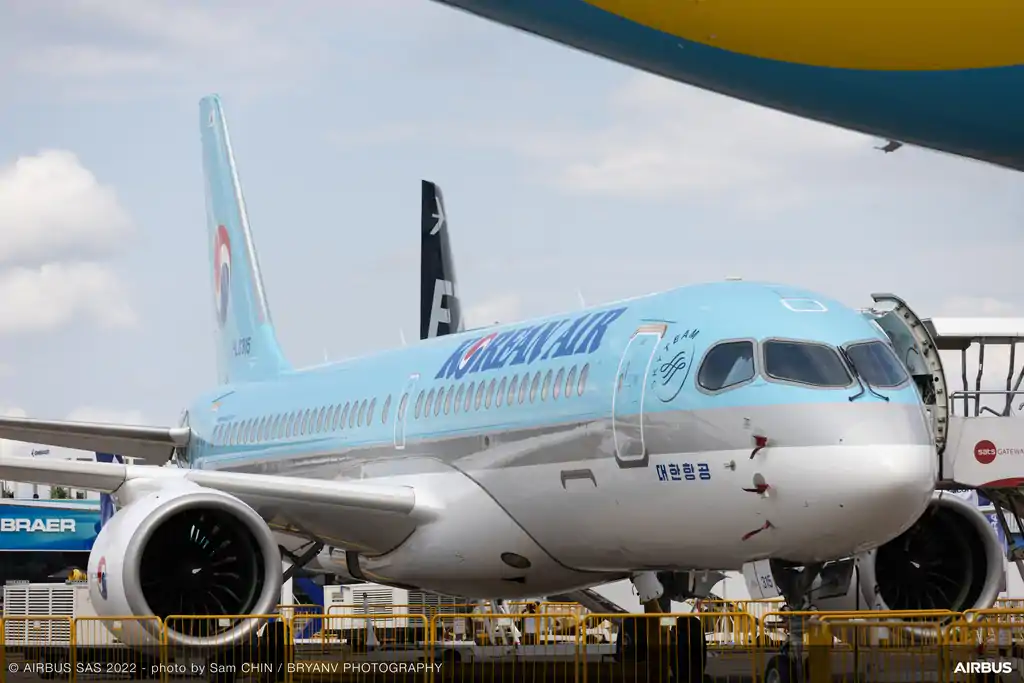
Korean Air, the flagship carrier of South Korea, reported a 12% decline in its operating profit for the second quarter of 2024, amounting to 413.4 billion won ($300 million). This downturn is attributed to escalating fuel and labor costs, according to the airline's announcement on Wednesday. The figure fell short of the consensus estimates of 468 billion won, compiled by market tracker FnGuide.
Record Revenue Yet Below Expectations
Despite the dip in operating profit, Korean Air's revenue soared to an unprecedented quarterly high of 4.02 trillion won, marking a 14% year-on-year increase. This is the first time the company's quarterly revenue has exceeded the 4 trillion won mark. However, it still fell short of the expected 4.3 trillion won.
Net Profit: A Slight Decline
For the three months ending in June, Korean Air's net profit reached 349 billion won, a decrease from the 371.5 billion won recorded during the same period last year. The airline attributed its underwhelming quarterly performance to "increased fuel and labor costs" and other "expenses associated with higher business volume."
Passenger Business Growth
Sales from the passenger business experienced a 10% year-on-year growth, thanks to the airline's expanded capacity across its networks, including China, and robust business and leisure demand to the Americas and Europe. This growth highlights the airline's strategic focus on expanding its reach and meeting the rising demand in key markets.
Strategic Moves for the Future
Korean Air has outlined its strategy to maximize profit by increasing flight frequencies and expanding charter operations during the peak summer travel months in the third quarter. This approach aims to capitalize on the high demand for travel and boost the airline's financial performance in the coming months.
Challenges and Opportunities Ahead
The rising operational costs, particularly fuel and labor, pose significant challenges for Korean Air. However, the airline's ability to achieve record revenue despite these hurdles demonstrates its resilience and potential for future growth. By strategically increasing capacity and optimizing operations, Korean Air aims to navigate these challenges and enhance its profitability.
Conclusion
Korean Air's second-quarter financial results present a complex picture of record-breaking revenue overshadowed by increased costs. As the airline gears up for the peak travel season, its focus on expanding operations and optimizing capacity will be crucial in driving future profitability. The coming months will be pivotal for Korean Air as it strives to balance growth and cost management in a dynamic market environment.
With Inputs from Korean JoongAng Daily
Read next

Akasa Air, India's youngest and greenest carrier, has marked its second anniversary with bold aspirations and significant achievements. Founder and CEO Vinay Dube, in a message to employees, projected Akasa Air’s climb into the top 30 global airlines by 2030, highlighting the airline’s commitment to rapid and sustainable growth.
Unprecedented Aircraft Orders Amid Delivery Uncertainties
Despite facing uncertainties in Boeing deliveries, Akasa Air has secured a firm order for 226 MAX aircraft within just 17 months of commencing operations. This remarkable feat is unprecedented for an Indian airline and positions Akasa Air for substantial expansion in the near future. The airline currently operates 24 aircraft and employs nearly 800 pilots.
However, Boeing’s last MAX delivery to Akasa occurred in February, raising concerns about future fleet growth. In response, Vinay Dube addressed these issues in a Town Hall meeting with pilots, assuring them that Akasa is evaluating Boeing’s delivery capabilities and considering alternative options to sustain its growth trajectory.
Pilots’ Concerns and Management’s Response
Pilots have voiced worries about slow training programs and reduced flying hours, impacting their earnings. Dube’s Town Hall meeting aimed to address these concerns, emphasizing the airline’s efforts to resolve these issues and ensure smooth operations and growth for its pilots.
Record-Breaking Growth and Operational Excellence
Since its inception on August 7, 2022, with its inaugural flight from Mumbai to Ahmedabad, Akasa Air has transported over 11 million passengers. The airline claims to have achieved triple-digit growth, positioning itself as the fastest-growing airline in global aviation history.
Dube highlights Akasa’s success in redefining air travel by maintaining reliability, service excellence, and affordability. Over the past year, Akasa has consistently led India’s aviation industry in on-time performance. The airline boasts the highest operational reliability and the lowest rates of customer complaints and flight cancellations among its competitors.
Expanding Workforce and Network
Akasa’s workforce has grown to over 4,000 employees, whom Dube credits for the airline’s accomplishments. Their dedication and passion have been instrumental in reaching these milestones. The airline’s network now spans 22 domestic and five international cities, operating more than 900 weekly flights. This expansion underscores Akasa’s rapid growth and increasing presence in both domestic and international markets.
The Future of Akasa Air
As Akasa Air celebrates its second anniversary, the airline is not just reflecting on its past achievements but is also looking forward to a future of continued growth and innovation. With ambitious plans, a dedicated workforce, and a strong commitment to sustainability, Akasa Air is set to redefine the landscape of air travel in India and beyond.
With Inputs from Economic Times
Comment